Powered by RedCircle
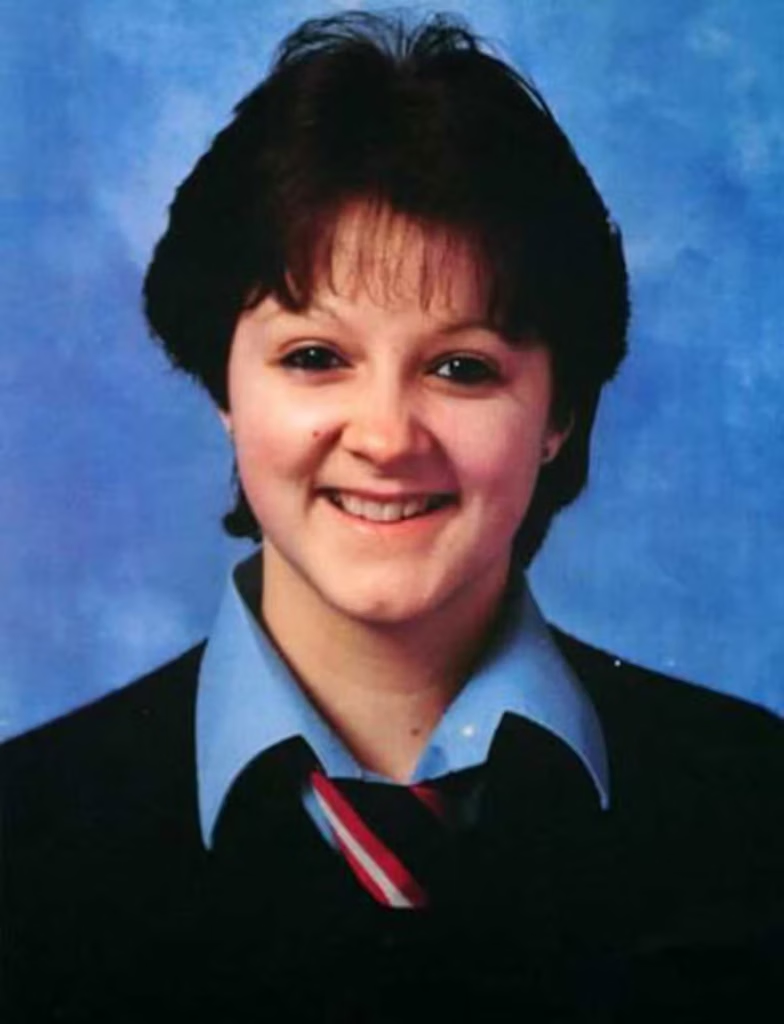
In October of 1983, sixteen-year-old Colette Aram left her home in Keyworth, Nottinghamshire, and began walking to her boyfriend’s house.
She never made it there.
The next morning, Colette’s body was found in a nearby field. She had been assaulted, strangled, and deliberately posed.
Investigators quickly realized they might be dealing with every detective’s nightmare: a stranger attack with no obvious connection between the victim and her killer.
Then, five weeks after Colette’s murder, Nottinghamshire Police received an anonymous letter.
The writer admitted to strangling Colette, taunted investigators for failing to identify him, and confidently told police:
“You will never get me.”
For decades, it looked like he might be right.
A Case That Made Crimewatch History
With few leads and no clear suspect, investigators turned to the public.
On June 7, 1984, Colette’s murder became the very first case ever featured on the BBC’s newly launched Crimewatch UK.
The program reconstructed the night she disappeared and appealed for information about the mysterious letter sent to police.
Hundreds of tips came in. Investigators eliminated more than a thousand potential suspects.
But Colette’s killer remained unidentified.
Years turned into decades, and even when her case was featured again for Crimewatch’s twentieth anniversary in 2004, her family still had no answers.
Evidence That Outlasted the Killer’s Secret
What the murderer could never have anticipated was how dramatically forensic science would change.
By 2008, Colette’s case was being reexamined with the help of Operation Stealth, a nationwide cold-case review.
Investigators returned to evidence that had been preserved since 1983, including material connected to a stolen red Ford Fiesta believed to have been used in Colette’s abduction, evidence from her clothing, the anonymous letter, and a paper towel recovered from the Generous Briton pub, where the killer had stopped shortly after the murder.
Using newer, more sensitive DNA testing, scientists were finally able to develop a genetic profile of the man who killed Colette.
But there was a problem.
His DNA wasn’t in the national database.
So investigators tried something different.
Familial DNA Changes Everything
Instead of searching only for an exact match, investigators began looking for DNA profiles that were genetically similar enough to suggest a close biological relationship.
Eventually, the DNA of a nineteen-year-old man entered the system and showed a familial connection to Colette’s killer.
That young man’s father was Paul Hutchinson.
In April 2009, police arrested Hutchinson, who was then fifty years old, married with children, and living only a short distance from where Colette had been murdered more than twenty-five years earlier.
His DNA directly matched the genetic profile developed from the preserved evidence.
And there was one more piece of confirmation.
A fingerprint preserved on the anonymous letter sent to police in 1983 was compared to Hutchinson after his arrest.
It matched.
The man who had once taunted police and confidently predicted that they would never catch him had unknowingly left behind the evidence that would eventually expose him.
What Happened to Colette Aram?
After his arrest, investigators were finally able to reconstruct the terrifying events surrounding Colette’s murder.
Earlier that day, Hutchinson had spent time hiding near a riding school, watching young girls. He later stole a red Ford Fiesta and drove through the Keyworth area, where he approached other girls before encountering Colette as she walked to her boyfriend’s house.
Colette was forced into the car at knifepoint, assaulted, and strangled. Her body was then left in a nearby field and deliberately posed.
The entire attack unfolded incredibly quickly.
In 2009, Hutchinson pleaded guilty to Colette’s murder. He was later sentenced to life in prison with a minimum term of twenty-five years.
For Colette’s family, the conviction finally answered the question of who had taken her life.
But one question remained.
Why Colette?
Hutchinson never gave them an answer.
Could There Be Other Victims?
Colette’s case also leaves behind another disturbing possibility.
Before Hutchinson encountered her, he had already been watching other young girls and had approached potential victims.
No other murders have been definitively attributed to him.
But after learning what he had been doing in the hours before Colette crossed his path—and knowing that he remained unidentified for more than two decades—it is difficult not to wonder whether there were other attacks or attempted attacks that were never connected to him.
Forensic Science Finally Catches Up
The murder of Colette Aram is a powerful reminder that a cold case is not necessarily a dead case.
Evidence that seemed insignificant or impossible to analyze in 1983 became incredibly valuable decades later.
A paper towel.
Cells left behind in a stolen car.
A fingerprint on a letter.
For more than twenty-five years, those pieces of evidence waited for forensic science to become advanced enough to understand what they could reveal.
And eventually, they identified the man who once believed he had gotten away with murder.
Listen to the full episode of Forensic Tales for the complete story of Colette Aram, the investigation that lasted more than two decades, and the forensic breakthrough that finally led police to Paul Hutchinson.